


.png)


Overview
At this year’s The Running Event in San Antonio, we did something different. Instead of just walking the floor, admiring new silhouettes, and talking performance stories, we turned the entire show into a live experiment.
We photographed dozens of the newest running shoes directly from the show floor and put them instantly into MakerLabs, our always-on consumer testing platform for rapid product feedback, to test with our running product-trained Digital Twins.
In real time, we captured true consumer reaction across different runner mindsets, from casual runners to race-focused athletes and true beginners. We got results and feedback from 250 digital twins on 55 products in one hour and seventeen minutes.
What we found reinforced a critical truth about today’s running market: there is no single “best” running shoe. The winner depends entirely on who is running, and why.
And that insight lines up perfectly with what we uncovered in our 2025 Running Landscape Report, where running today is defined just as much by emotional wellbeing, lifestyle, and confidence as it is by raw performance.
The Big Picture: Running Is Now a Lifestyle, Not Just a Workout
Before looking at the shoes themselves, it is important to understand the mindset of today’s runner.
According to our US Running Landscape Study:
- 74 percent of runners run at least weekly, showing a large, consistent base of participation
- 60 percent say comfort and cushioning matter most when choosing shoes
- 59 percent say running helps them manage stress
- 44 percent want stylish yet performance-ready designs
- 58 percent want affordable everyday-use shoes that still perform
Running is no longer a narrow performance sport. It lives at the intersection of performance, lifestyle, community, and recovery, with shoes increasingly expected to perform on the run and in everyday life.
That context becomes critical when you look at who won in each segment at TRE.
Nike Wins With Casual Runners: Brand Power Still Matters
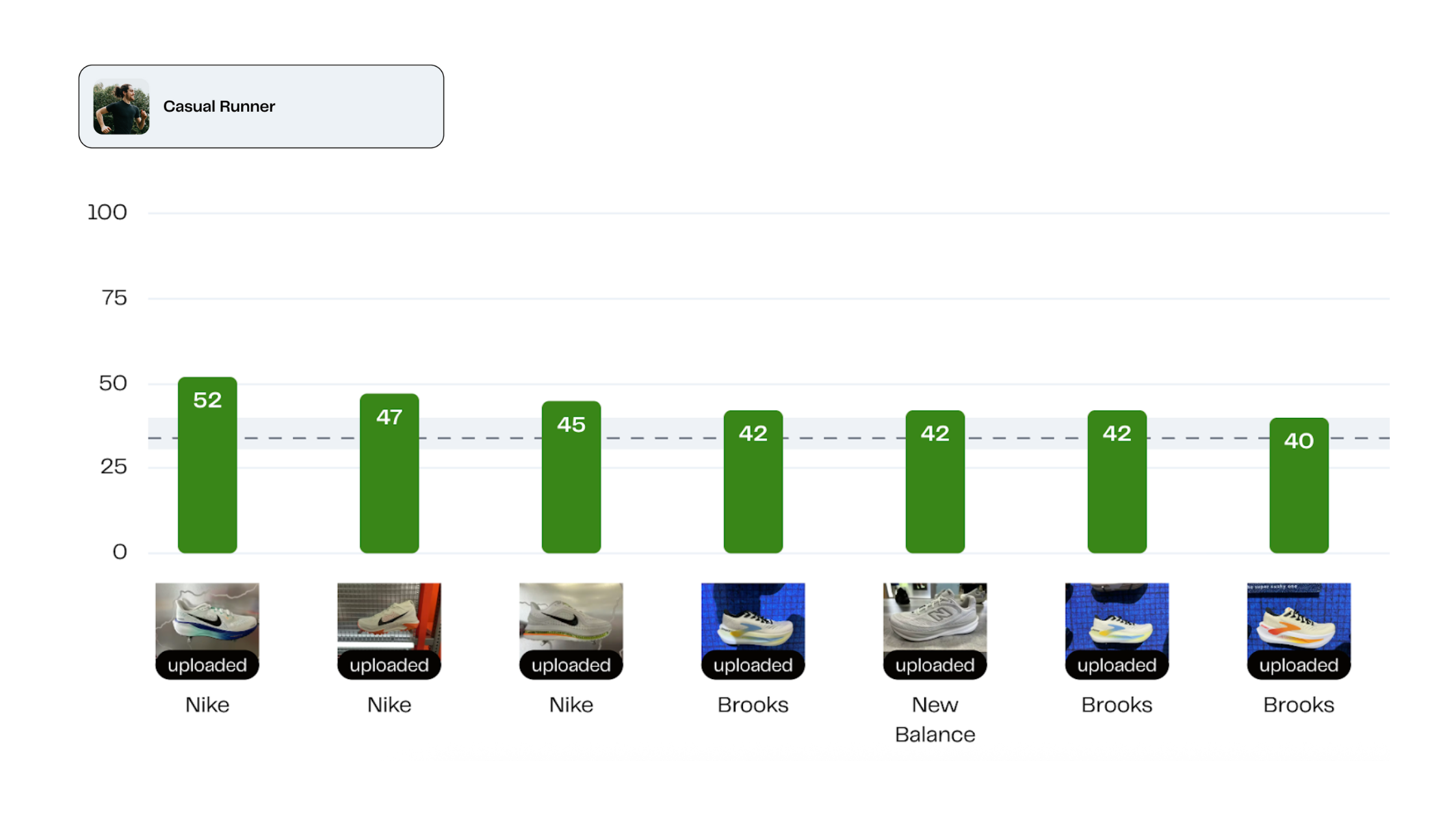
When we tested the TRE shoes with our Digital Twins, one brand rose clearly to the top: Nike.
Across the overall runner audience, Nike models consistently ranked at the top for consumer sentiment, appeal, and confidence. But when we peeled back the layers, we saw that Nike’s dominance was driven most heavily by Casual Runners, rather than more performance or fitness oriented runners.
These runners:
- Run occasionally or without rigid training goals
- Prioritize comfort, versatility, and style
- Are highly influenced by brand awareness and familiarity
This aligns directly with the Running Landscape insight that nearly half of runners use their running shoes for everyday wear, not just dedicated runs.
Nike’s advantage here is not just product. It is trust at scale. When a casual runner sees a Nike shoe, it already feels safe, proven, and wearable beyond the run. This explains why Nike consistently wins in broad, mixed-audience testing even when technical performance is not the primary decision driver.
Brooks Takes Over With Performance-Oriented Runners
The story changes dramatically when we isolate performance-oriented runners. These are the runners who:
- Train for races
- Run marathons or structured mileage
- Track data and improvement
- Care deeply about ride, durability, and recovery
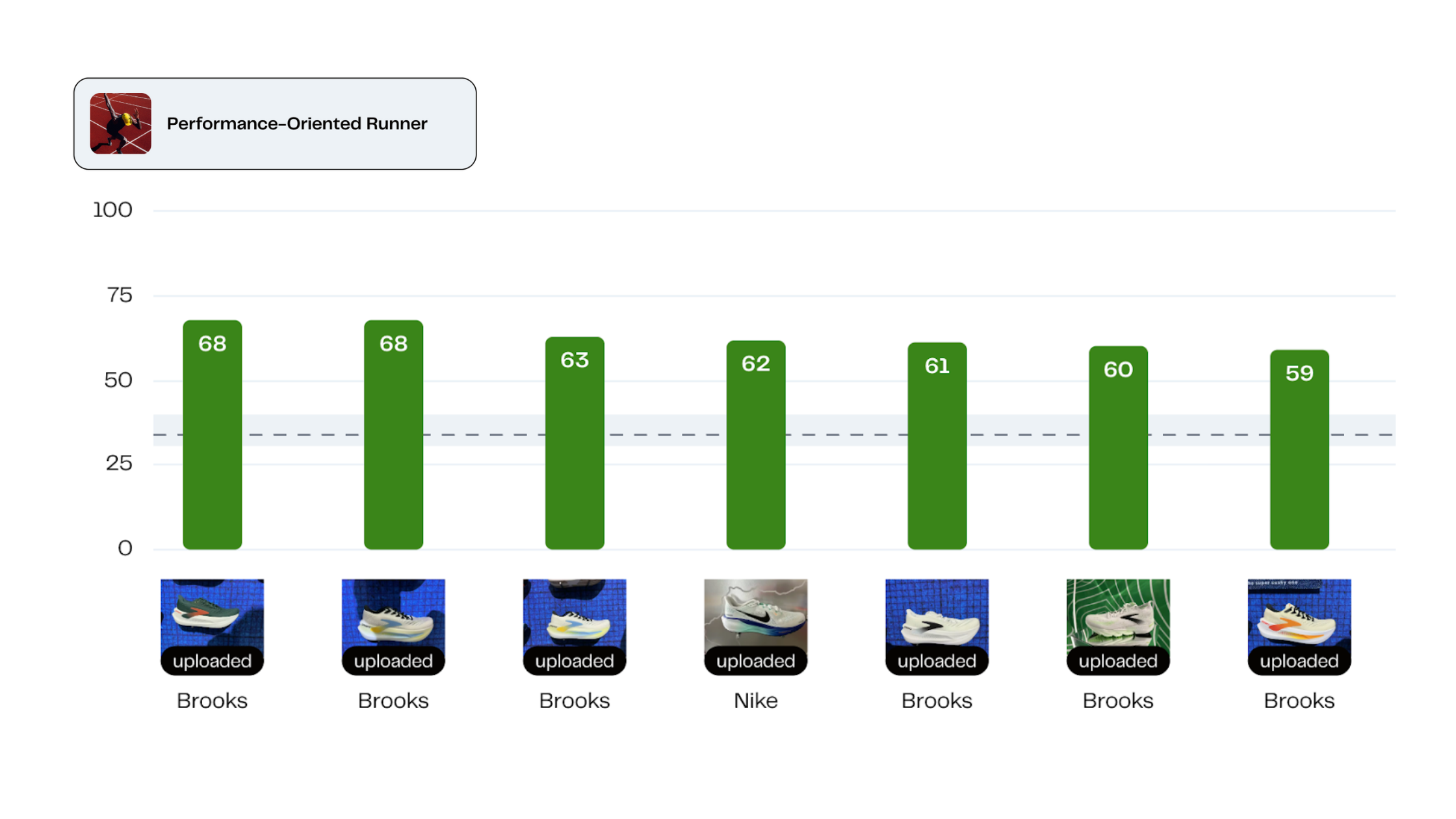
In this segment, Brooks quickly emerges as the top performer across multiple models.
Most notably, the Brooks Glycerin Flex stood out as one of the strongest performers in performance-focused testing. This is especially powerful given that the Glycerin Flex was recently named one of the “Darlings of TRE” and highlighted as a key emerging trend product for 2026.
This outcome maps cleanly to what we see in the broader data:
- 54 percent of runners prioritize durability
- 60 percent value cushioning as a performance feature
- Brands are heavily investing in superfoam midsoles and recovery-driven builds
Performance runners are not chasing logo recognition. They are chasing feel, protection, and miles without breakdown. Brooks wins here because its brand DNA is deeply rooted in technical trust and underfoot performance, not cultural cachet.
Beginner Runners Choose the HOKA Clifton for Confidence
One of the most important insights from our live testing came from the Beginner Runner segment.
These runners face the highest friction:
- Confidence issues
- Fear of injury
- Perception that running gear is too expensive
- Uncertainty about what shoe is “right”
The Running Landscape Report shows that 59 percent of runners feel gear is overpriced, making confidence and perceived value even more important for beginners.
For this audience, the top-performing shoe was the HOKA Clifton.
Why? Because the Clifton delivers three things beginners crave:
- Immediate softness underfoot
- A stable, protective ride
- A visual signal that the shoe is doing the work for you
In a market where comfort is the number-one “pick one” purchase driver at 42 percent, HOKA’s maximal cushioning becomes not just a technical feature. It becomes a confidence tool.

The Strategic Takeaway: There Is No Single “Best” Running Shoe
What TRE testing made clear is this:
- Nike wins when lifestyle, familiarity, and brand trust dominate the decision
- Brooks wins when performance, durability, and race preparation lead the mindset
- HOKA wins when comfort, protection, and confidence define success
And that is exactly what today’s running market demands. The future of running is not about one perfect performance shoe. It is about building for multiple running lives at once:
- Stylish performance
- Emotional wellbeing
- Community connection
- Recovery and approachability
All at the same time.
Why This Matters for Brands Right Now
This experiment also reinforces one of the most important truths in modern footwear retail:
You cannot test one shoe with one consumer and expect to understand performance.
Runners are not a monolith. They exist across emotional, physical, social, and identity-driven dimensions. The brands that win will be the ones that:
- Develop with multiple runner archetypes in mind
- Pressure-test products early across segmented audiences
- Align performance innovation with emotional payoff
This is exactly why live testing at TRE with Digital Twins was so powerful. It lets us see, in real time, how different runners respond differently to the same wall of shoes, before those shoes ever hit retail shelves.
Key Takeaways
Methodology
At this year’s The Running Event in San Antonio, we did something different. Instead of just walking the floor, admiring new silhouettes, and talking performance stories, we turned the entire show into a live experiment.
We photographed dozens of the newest running shoes directly from the show floor and put them instantly into MakerLabs, our always-on consumer testing platform for rapid product feedback, to test with our running product-trained Digital Twins.
In real time, we captured true consumer reaction across different runner mindsets, from casual runners to race-focused athletes and true beginners. We got results and feedback from 250 digital twins on 55 products in one hour and seventeen minutes.
What we found reinforced a critical truth about today’s running market: there is no single “best” running shoe. The winner depends entirely on who is running, and why.
And that insight lines up perfectly with what we uncovered in our 2025 Running Landscape Report, where running today is defined just as much by emotional wellbeing, lifestyle, and confidence as it is by raw performance.
The Big Picture: Running Is Now a Lifestyle, Not Just a Workout
Before looking at the shoes themselves, it is important to understand the mindset of today’s runner.
According to our US Running Landscape Study:
- 74 percent of runners run at least weekly, showing a large, consistent base of participation
- 60 percent say comfort and cushioning matter most when choosing shoes
- 59 percent say running helps them manage stress
- 44 percent want stylish yet performance-ready designs
- 58 percent want affordable everyday-use shoes that still perform
Running is no longer a narrow performance sport. It lives at the intersection of performance, lifestyle, community, and recovery, with shoes increasingly expected to perform on the run and in everyday life.
That context becomes critical when you look at who won in each segment at TRE.
Nike Wins With Casual Runners: Brand Power Still Matters
When we tested the TRE shoes with our Digital Twins, one brand rose clearly to the top: Nike.
Across the overall runner audience, Nike models consistently ranked at the top for consumer sentiment, appeal, and confidence. But when we peeled back the layers, we saw that Nike’s dominance was driven most heavily by Casual Runners, rather than more performance or fitness oriented runners.
These runners:
- Run occasionally or without rigid training goals
- Prioritize comfort, versatility, and style
- Are highly influenced by brand awareness and familiarity
This aligns directly with the Running Landscape insight that nearly half of runners use their running shoes for everyday wear, not just dedicated runs.
Nike’s advantage here is not just product. It is trust at scale. When a casual runner sees a Nike shoe, it already feels safe, proven, and wearable beyond the run. This explains why Nike consistently wins in broad, mixed-audience testing even when technical performance is not the primary decision driver.
Brooks Takes Over With Performance-Oriented Runners
The story changes dramatically when we isolate performance-oriented runners. These are the runners who:
- Train for races
- Run marathons or structured mileage
- Track data and improvement
- Care deeply about ride, durability, and recovery
In this segment, Brooks quickly emerges as the top performer across multiple models.
Most notably, the Brooks Glycerin Flex stood out as one of the strongest performers in performance-focused testing. This is especially powerful given that the Glycerin Flex was recently named one of the “Darlings of TRE” and highlighted as a key emerging trend product for 2026.
This outcome maps cleanly to what we see in the broader data:
- 54 percent of runners prioritize durability
- 60 percent value cushioning as a performance feature
- Brands are heavily investing in superfoam midsoles and recovery-driven builds
Performance runners are not chasing logo recognition. They are chasing feel, protection, and miles without breakdown. Brooks wins here because its brand DNA is deeply rooted in technical trust and underfoot performance, not cultural cachet.
Beginner Runners Choose the HOKA Clifton for Confidence
One of the most important insights from our live testing came from the Beginner Runner segment.
These runners face the highest friction:
- Confidence issues
- Fear of injury
- Perception that running gear is too expensive
- Uncertainty about what shoe is “right”
The Running Landscape Report shows that 59 percent of runners feel gear is overpriced, making confidence and perceived value even more important for beginners.
For this audience, the top-performing shoe was the HOKA Clifton.
Why? Because the Clifton delivers three things beginners crave:
- Immediate softness underfoot
- A stable, protective ride
- A visual signal that the shoe is doing the work for you
In a market where comfort is the number-one “pick one” purchase driver at 42 percent, HOKA’s maximal cushioning becomes not just a technical feature. It becomes a confidence tool.
The Strategic Takeaway: There Is No Single “Best” Running Shoe
What TRE testing made clear is this:
- Nike wins when lifestyle, familiarity, and brand trust dominate the decision
- Brooks wins when performance, durability, and race preparation lead the mindset
- HOKA wins when comfort, protection, and confidence define success
And that is exactly what today’s running market demands. The future of running is not about one perfect performance shoe. It is about building for multiple running lives at once:
- Stylish performance
- Emotional wellbeing
- Community connection
- Recovery and approachability
All at the same time.
Why This Matters for Brands Right Now
This experiment also reinforces one of the most important truths in modern footwear retail:
You cannot test one shoe with one consumer and expect to understand performance.
Runners are not a monolith. They exist across emotional, physical, social, and identity-driven dimensions. The brands that win will be the ones that:
- Develop with multiple runner archetypes in mind
- Pressure-test products early across segmented audiences
- Align performance innovation with emotional payoff
This is exactly why live testing at TRE with Digital Twins was so powerful. It lets us see, in real time, how different runners respond differently to the same wall of shoes, before those shoes ever hit retail shelves.


.png)
From the Founders Newsletter
A bi-weekly note from Dan and Matt.
Sign up to learn more on consumer insights, synthetic research, and the future of retail, with takeaways you can put to work today.


